

Dancing in Hell: How Dr. Edith Eger Chose Freedom in Auschwitz and Beyond

In the suffocating darkness of a cattle car bound for Auschwitz in May 1944, a mother pressed close to her sixteen-year-old daughter and whispered words that would become a lifeline:
“No one can take away from you what you put in your own mind.”
Those words belonged to Edith Elefánt, a gifted Hungarian ballerina whose dreams of Olympic gymnastics and European stages had just been shattered by the Holocaust. What happened next would test the limits of human endurance—and prove that the mind can remain free even when the body is in chains.
The Angel of Death and The Blue Danube
Upon arrival at Auschwitz, Edith and her sister Magda stood before Dr. Josef Mengele during the infamous selection process. When he asked if the woman beside her was her mother or sister, Edith answered honestly: “My mother.”
Mengele’s finger pointed left. Her mother walked toward the gas chambers. Edith tried to follow, but Mengele stopped her with a chilling lie: “You’ll see her soon—she’s just going to take a shower.”
That same evening, Mengele returned to the barracks seeking entertainment. Fellow prisoners, knowing Edith’s background in dance, pushed her forward. Dance, they urged, or we all suffer.
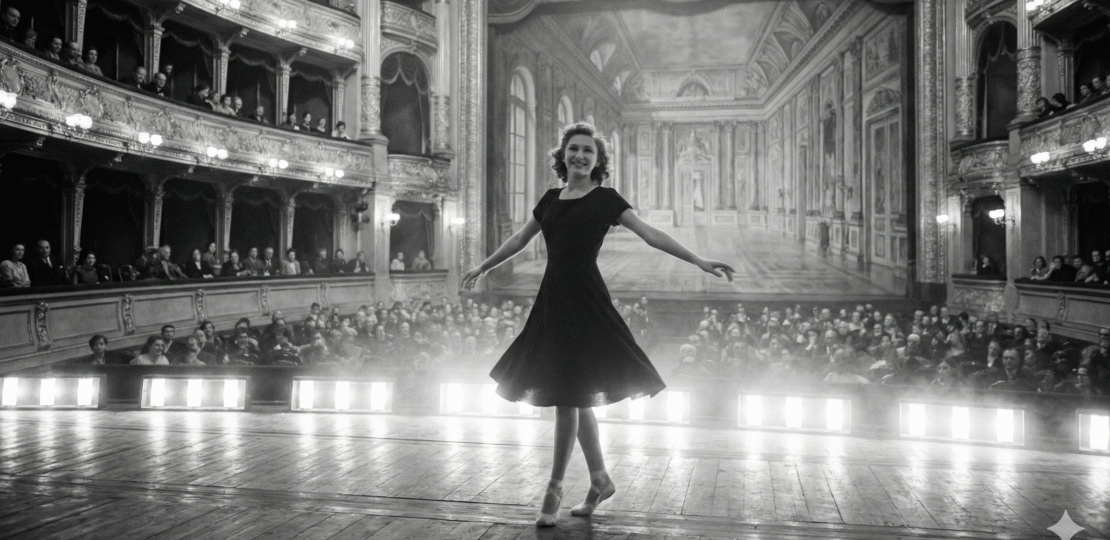
In striped rags, grieving her mother’s murder hours earlier, sixteen-year-old Edith closed her eyes and began to dance to The Blue Danube. In her mind, the filthy barracks became the grand Budapest Opera House. She was no longer a prisoner—she was a prima ballerina lost in Romeo and Juliet.

As she danced, something astonishing happened. Looking at Mengele, the man who had just sent her mother to her death, Edith felt… pity.
“I am free in my mind,” she realized. “He will never be. He has to live with what he’s done. He is the real prisoner.”
When she finished with a graceful split, Mengele tossed her a loaf of bread—a reward that would save not just her life, but others’.
The Bread That Became Legs
Edith didn’t hoard the bread. She shared it with Magda and the starving women around her, giving pieces to those who needed it most.
Months later, during a brutal 55-kilometer death march from Mauthausen to Gunskirchen in the Austrian winter, Edith collapsed. Her body had nothing left.
Then a girl recognized her—one of the women she had fed with Mengele’s bread. That girl and others lifted Edith onto their shoulders and carried her the rest of the way. The small act of kindness months earlier became the strength that kept her alive.
When American troops liberated Gunskirchen in May 1945, Edith weighed just seventy pounds. She had a broken back, typhoid, pneumonia, and pleurisy. Buried in a pile of bodies, she heard a soldier call out: “Raise your hand if you can hear me.”
A weak hand moved. It was hers.
From Survivor to Healer
Edith built a new life in America with her husband Béla, raising three children and earning a doctorate in psychology. For decades, though, she kept Auschwitz locked away. She never told her children. Triggers—crowded spaces, certain smells—could still ambush her with flashbacks.
Freedom of body had come in 1945, but freedom of mind took longer.
The turning point came in 1990 when, at age sixty-two, Edith returned to Auschwitz. Walking through the gates again, she finally allowed herself to feel the grief, guilt, and rage she had buried. Standing where her mother had last touched her, she discovered something radical: forgiveness—not for the Nazis, but for herself.
She forgave herself for surviving when her mother didn’t. For the truthful answer that sent her mother to death. For simply being alive.
In 2017, at ninety years old, Dr. Edith Eger published The Choice: Embrace the Possible. The book became a global bestseller, translated into over forty languages, reaching millions with the lesson she learned in hell:
The worst prison is not built by others. It’s the one we build in our own minds. And we already hold the key.

The Lesson for All of Us—and How MindSavi Can Help
Today, in her late nineties, Dr. Eger continues working as a clinical psychologist specializing in trauma and PTSD. She trains military personnel, counsels survivors of abuse, and helps people dismantle the mental cages they’ve built around regret, resentment, and fear.
Every Sunday, she still dances—swing dancing to the music American soldiers played when they freed her eighty years ago.
Her life is a living reminder: No matter what happens to us, we retain the power to choose our response. Suffering can be transformed into wisdom. And forgiveness—especially of ourselves—liberates the future.
At MindSavi, we built our app around this exact truth. MindSavi is a daily companion designed to help you cultivate mental freedom through guided meditations, journaling prompts, mood tracking, cognitive exercises, and personalized insights—all rooted in evidence-based psychology. Just as Dr. Eger learned to choose her thoughts even in the darkest moments, MindSavi gives you practical tools to reframe negative patterns, release self-imposed limitations, and build resilience one mindful choice at a time.
Whether you’re carrying old wounds, daily stress, or simply want to live with more clarity and peace, MindSavi meets you where you are and helps you unlock the same inner freedom Edith discovered.

Sign-up for MindSavi today at MindSavi.com.
Start today and take the first step toward choosing your own freedom—because the key is already in your pocket.
As Dr. Eger writes in The Choice:
“The worst that can happen is not what others do to us. It is what we do to ourselves in return.”
Dr. Edith Eger didn’t just survive the unimaginable—she showed us how to truly live. Let MindSavi help you do the same.
Sources and Further Reading
This article is based on the extraordinary life story of Dr. Edith Eva Eger, as detailed in her New York Times bestselling memoir The Choice: Embrace the Possible. Key elements—including her arrival at Auschwitz, dancing for Dr. Josef Mengele to “The Blue Danube,” sharing the bread, the death march, and her philosophy of mental freedom—are drawn from her own accounts.
- Official website (includes videos, book info, and her biography)
- Book page and details
- Exclusive book excerpt (includes the dance scene)
- USC Shoah Foundation testimony (video of her describing dancing for Mengele)
- CNN article on her experience
Dr. Eger continues to share her message of resilience and choice in her work as a psychologist.
RELATED POSTS
View all




René Descartes and Dualism – The Pineal Gland as the Seat of the Soul Chapter 14 of Volume 1 of the Faith Based Edition
January 8, 2026 | by David Czerwinski